EXODUS Shows a Full Mission in Its New Liberating the Kay Gameplay Demo
5 min read
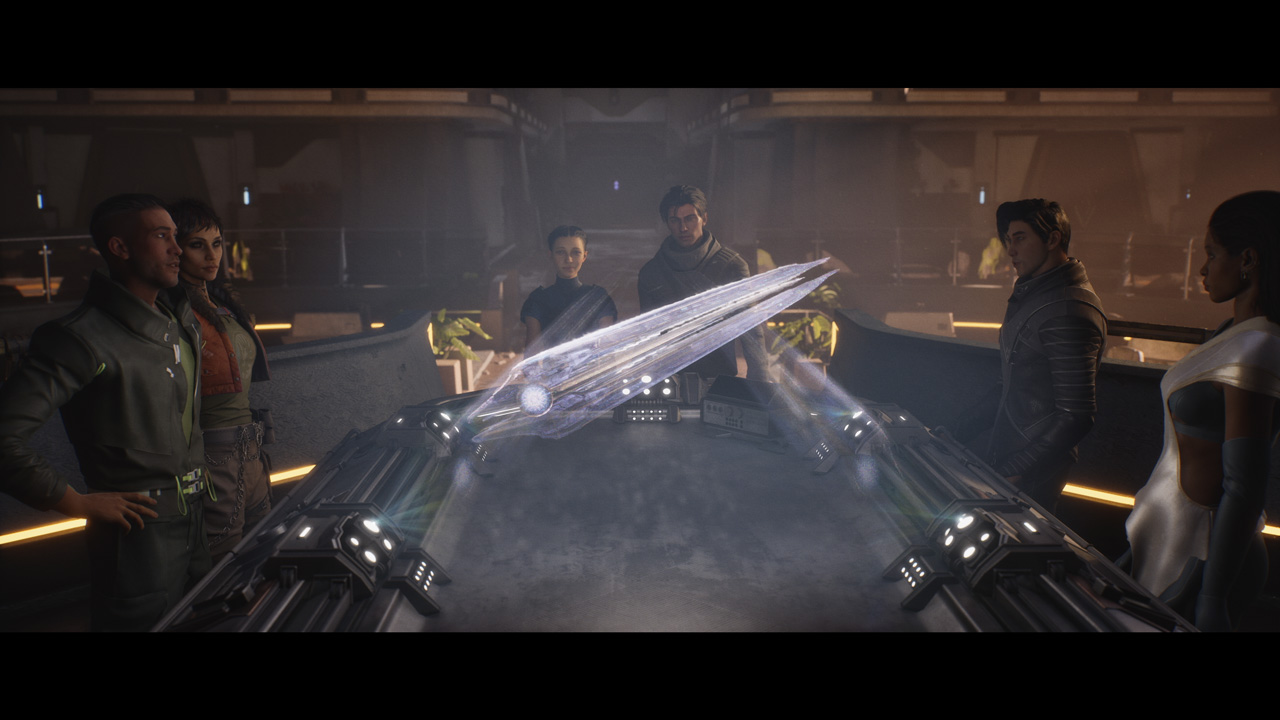
Official EXODUS mission image. © Wizards of the Coast / Archetype Entertainment.
EXODUS has a substantial new gameplay showcase built around a mission called Liberating the Kay. Archetype Entertainment released the update on October 28, offering a closer look at combat, companions and choices inside its science-fiction RPG.
The roughly 40-minute presentation follows Jun Aslan to Khonsu, an orbital defence platform above the homeworld of Lidon. It is a longer look at the game’s rhythm than a trailer can provide, moving between conversations, exploration and fighting.
The official mission breakdown places this section several hours into the adventure. Jun needs ship components from Suliman Tenjin, but securing his help means doing him a favour first.
Khonsu is home to the Kay, a community of Awakened frogs. Jun’s half-brother Gideon Aslan has seized it. The mission therefore combines a practical need for supplies with a conflict involving family, power and the future of another community.
The choices go beyond a conversation prompt
Archetype highlights three decisions: whether to help a wounded enemy, how to obtain a guard’s keycard, and whether to alter beacons to secure the Kay’s loyalty. The developer associates these with the Paladin and Immortal moral paths.
The last example is the most interesting on paper. Protection can come with a price, and a request for loyalty can become a demand for control. That gives a rescue mission an uncomfortable question about who benefits after the fighting stops.
This is where a long gameplay presentation is useful. A short trailer can show a dramatic decision without explaining the pressure behind it. A fuller mission gives viewers more room to understand what the protagonist needs and what others want in return.
The strength of those choices will depend on how the finished game follows through. Different dialogue is one kind of response. Changes to relationships, later opportunities or the community itself would create a more lasting sense of consequence.
That is an expectation to test, not something this preview proves across the entire campaign. The footage establishes the kind of decisions EXODUS wants players to make. It cannot yet show every result of every route over a full playthrough.
Jun’s mission starts with a dying home
The official character and world guide describes Jun as a salvager who becomes a Traveler. Players can choose a male or female Jun and customise appearance, equipment and moral alignment.
Lidon faces the Rot, a threat linked to Celestial technology. Jun’s journey involves reaching beyond home and obtaining technology that might help people survive. The Celestials are themselves a far-future evolution of humanity, rather than a simple unrelated alien species.
The setting also includes the Awakened: animals with self-awareness and human-level intelligence. That makes the Kay part of a broader society, rather than an isolated visual joke. Other announced characters include an Awakened wolf and an octopus.
Those ideas give the mission’s politics more weight. If the Kay are people with a community and future, their freedom cannot be treated merely as a resource reward. The game’s writing will need to make that personhood clear through more than exposition.
A good test is whether players remember individual concerns after the mission ends. A strange species design can attract attention immediately. Distinct personalities and interests are what make a community matter once the novelty wears off.
Companions belong in the action
Suliman accompanies Jun rather than only issuing the request from a safe distance. The presentation also includes Elise, zero-gravity fighting, optional paths and a use for the Gauntlet’s Petrify ability against an environmental obstacle.
Those elements suggest that the mission is designed to alternate between different kinds of decisions. A conversation asks what Jun believes. An obstacle asks how to use an ability. A fight asks how to respond while under pressure.
The transition between those situations matters as much as any single ability. If exploration, dialogue and combat feel disconnected, a mission can become a series of separate demonstrations. If they support each other, the same location can feel like a coherent place.
TheSixthAxis’s coverage identifies the video as a full 40-minute mission showcase. That length gives viewers a chance to judge pacing rather than relying only on fast edits and isolated finishing moves.
It still remains selected pre-release footage. It does not establish final performance across every platform, loading behaviour throughout the campaign or how often encounters repeat. Those questions need wider access to the finished game.
Time gives the wider story another cost
The official EXODUS site presents the game as a single-player, third-person science-fiction RPG. It is planned for April 7, 2027 on PlayStation 5, Xbox Series X|S and PC.
Time dilation is central to its premise. Travelers can experience a much shorter journey than the people they leave behind. Returning home can therefore involve more than bringing back equipment; it can mean confronting how much has changed during an absence.
That creates a potential link between individual choices and long-term consequences. A promise made before leaving might be remembered very differently after years have passed. A relationship cannot simply be placed on hold because the protagonist has another destination.
The idea is especially suited to a story about saving a homeworld. Success measured only in technology would miss the human cost of the trip. The most effective version would make players care about what survival preserves, and what time takes away.
The Khonsu showcase does not answer every question about that larger structure. Its value is more immediate: it shows how a local mission can place personal needs beside someone else’s future. That is a useful foundation for the broader premise.
What to watch for in the next demonstration
The next revealing step would be seeing a consequence return in a later section. That could show how the game remembers a choice after the immediate dialogue has ended. It would also help distinguish lasting decisions from short-lived reactions.
More unbroken gameplay from different environments would clarify combat variety. Viewers can already inspect this mission’s pace, but one location cannot represent every encounter. Different enemy pressures and companion combinations would provide a stronger basis for comparison.
For now, Liberating the Kay is a useful place to start if EXODUS previously seemed defined by its broad science-fiction promises. It gives those promises a location, a community and a series of decisions with understandable stakes.
Watch the full showcase through Archetype’s official breakdown if you want that detail. It is an extended look at a game still in development, with enough space to examine how its conversations and combat fit together.