Destiny 2 unvaulting: Bungie names returning campaigns and explains the long timeline
5 min read
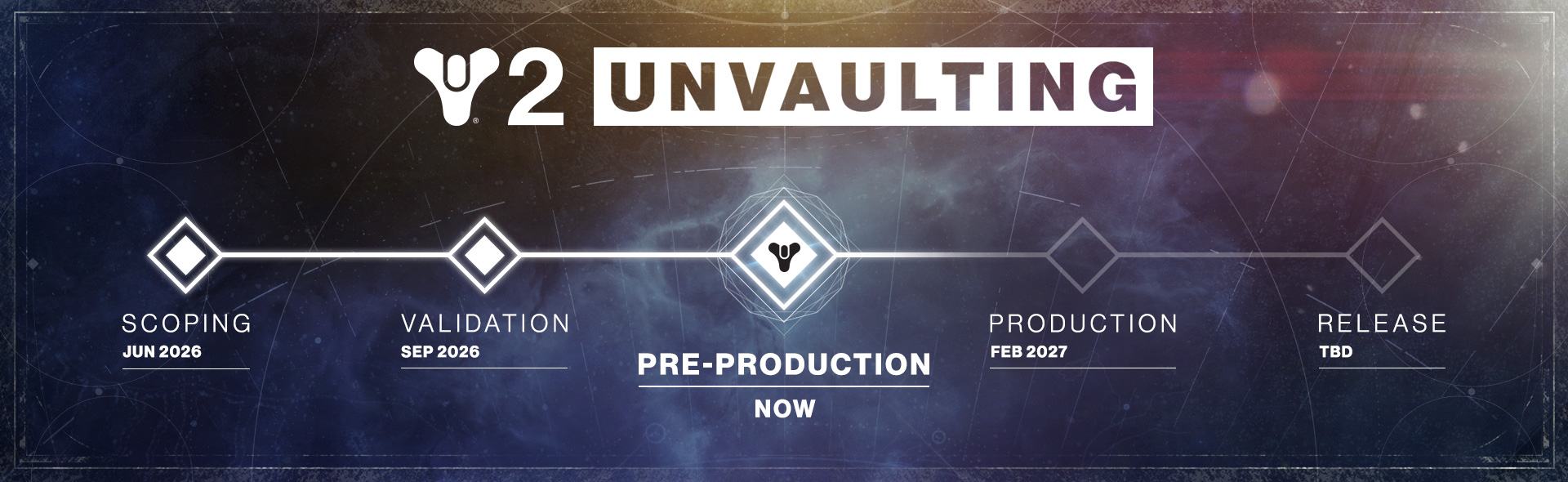
Image: Bungie.
Bungie has clarified what it wants to restore to Destiny 2 and how far away that work remains. Its October 29 community update targets the Red War, Curse of Osiris, Warmind and Forsaken campaigns, associated Strikes, Raids and Raid Lairs, plus Menagerie with refreshed rewards. The first pass is intended for all players.
Pre-production is expected to continue until roughly January or February 2027, followed by about 12 months of full production. That points towards early 2028 if the estimate holds, but Bungie has not announced a release date. Its progress graphic explicitly leaves release as to be determined.
Free-roam destinations, seasonal activities, raid weapon updates and PvP maps are stretch goals. Seasonal story missions, seasonal hubs, Kell’s Grave and a revised New Light experience currently have no path to inclusion. Bungie also names future Celebration and Legacy efforts, with more progress information expected in February. Those labels do not confirm a Destiny 1 PC release.
What restoring a campaign actually means for players
A campaign is more than a collection of locations. It provides an order for discoveries, introduces characters and gives later events a point of reference. When that sequence is missing, a new player can learn the facts through a summary without experiencing why those facts mattered in play.
Restoration therefore has two audiences. Veterans may want to revisit something attached to a particular group of friends or period of their lives. Newcomers may simply want the opportunity to play an important part of the story from the beginning. The same content can serve both purposes without needing to feel brand new.
That does not mean every returning mission will automatically match a player’s memory. Familiar experiences are filtered through the time when they were first played. A favourite encounter can feel different with a new group, different equipment or a better understanding of its mechanics.
The useful promise of restoration is access. It lets people form or revisit their own judgement instead of relying on archived videos and somebody else’s account of what the game used to be.
Why the work is not a simple switch
In its September Next Chapter announcement, Bungie explained that bringing old content back involves updating lighting, encounters, combatants and underlying systems to work with the current game. The studio linked the restoration effort to repairing trust after content removal and said the returning experiences would be available to all Destiny 2 players.
That explanation makes the production timeline easier to understand, even if it does not make the wait more welcome. An old activity has to function within the game people can install now. A mission that loads but breaks at a progression step would not be a successful return.
The important standard is whether the result can be played reliably from start to finish. That includes ordinary transitions, reward delivery and the points where a fireteam changes its membership or resumes a session. These are general examples of the kinds of experience a restoration should preserve, not a list of specific defects Bungie has reported.
There is also a presentation question. Returning content needs a clear place in the current game so that people can find it and understand its sequence. Making something technically available is only the first part of making it approachable.
A stretch goal is not a launch promise
The most useful part of the update is its separation of priorities. A clearly named first pass is easier to assess than a broad statement that everything will return someday. It tells players what the team is trying to deliver before considering the additional possibilities.
The distinction can easily disappear in a headline or a social post. A reader sees a favourite activity mentioned and reasonably assumes it belongs to the same commitment as the campaigns. That is why the categories matter: being investigated is different from being part of the initial target.
For the same reason, an item outside the current plan should not be described as permanently impossible. The announcement sets out the position now. Future decisions may change, but there is no basis for promising that they will change in the direction a particular player wants.
The sensible way to follow this project is to keep those groups separate. When Bungie provides another update, compare what has moved, what has stayed uncertain and what has been removed or added. That provides a clearer measure of progress than enthusiasm alone.
The timeline needs careful wording
Adding a year of production to an early-2027 starting point produces an approximate early-2028 window. It is arithmetic based on the studio’s estimate, not a new announcement. If the pre-production phase takes longer, the implied window moves too.
Readers should therefore be cautious with a headline that presents 2028 as a locked release year, let alone a particular month. A development estimate can be useful without carrying the certainty of a dated launch announcement. Reporting that distinction is especially important for a project that is still proving its production process.
The next meaningful checkpoint is whether the team reports that it has reached the next stage and can demonstrate the work. A progress update need not contain a trailer to be valuable. A specific account of completed work, remaining obstacles and any change in scope can tell players more than another broad promise.
Trust will depend on the playable result
For an ongoing game, preservation is a practical question as much as an emotional one. Can a friend join later and experience the events everyone else keeps referencing? Can a returning player revisit an old campaign without having to reconstruct it from clips? Those questions shape how easy it is to recommend a long-running world to somebody new.
Bungie’s plan addresses that problem directly, but the announcement is the beginning of the work players will ultimately judge. Clear communication helps set expectations. A stable, accessible restoration is what would make those expectations worth having.
The current takeaway is specific: named campaigns and activities are being targeted, extra content remains conditional, and the production estimate describes a long project. Keep an eye on the February update, while treating a release date as unannounced until Bungie actually supplies one.