Age of Wonders 4 The Silver Seas is out with ocean cities, pirates and Sharkkin
5 min read
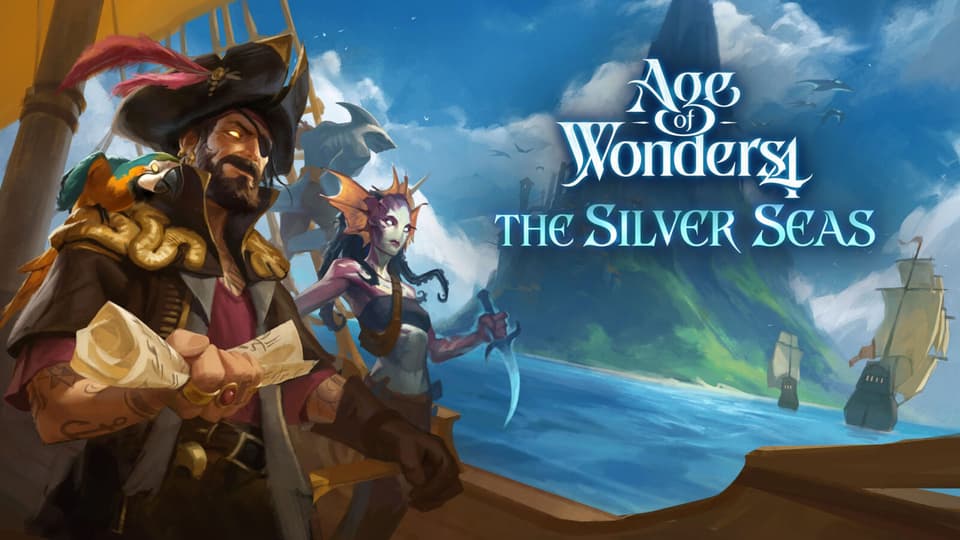
Image: Triumph Studios / Paradox Interactive / Xbox Wire
Age of Wonders 4 has taken its empire-building ambitions further out to sea. The Silver Seas expansion launched on November 3, bringing a nautical theme that includes ocean settlements, pirate identities and new forms for the people of your fantasy empire.
The new content gives returning players a clear reason to consider a different kind of campaign. Instead of treating water mainly as the space between familiar destinations, the expansion’s central idea makes it part of where an empire can establish itself. That is a more substantial change of emphasis than adding another set of decorative pirate outfits.
The main additions confirmed by Triumph
The new Mercantile Culture can establish cities at sea and develop them into floating fortresses. Its two approaches are the Cartel, associated with smuggling and secrecy, and the Barony, which uses wealth for bounties and imports.
The expansion also introduces Sharkkin and Aqualon forms, water and ice magic, Pirate Dwellings, pirate-themed stories and sea creatures. In the developer announcement, game director Tom Bird says community requests helped shape the expansion, including the interest in more sea-based play and shark-like inhabitants.
Those are the confirmed foundations of the release. The announcement is not a complete balance guide, so claims about the strongest build, fastest economy or best competitive strategy would be premature without more detailed evidence.
Why ocean cities change the campaign fantasy
In a strategy game, the place where you can build influences how you imagine an empire. A coastal power and an inland kingdom may already suggest different stories, but a settlement on the water pushes that distinction further. It lets the location itself become part of the faction’s identity.
The appeal is partly strategic and partly imaginative. Some players will want to investigate the practical opportunities of the new culture, while others will start with a theme: a secretive trading network, a wealthy maritime court or an empire of shark-like people. Both are valid reasons to begin another campaign.
Our reading of the announcement is that The Silver Seas is trying to connect those motivations. The pirate theme is attached to a culture and settlement concept, giving players something to build a campaign around rather than a visual idea that ends at the faction-creation screen.
That does not tell us how every map will play. Terrain, neighbours and the choices made during a campaign still matter. The useful starting question is what kind of situation you want the new tools to create, rather than whether a single feature automatically guarantees an advantage.
Cartel or Barony: start with the story you want
The two identities offer an immediate way to distinguish campaigns. A player attracted to secrecy and smuggling may find the Cartel description more appealing. Someone who likes the idea of wealth shaping relationships and conflict may be drawn to the Barony.
Before worrying about optimisation, choose the approach you actually want to explore. A strategy campaign asks for many decisions over time, and enjoying the theme can make those decisions more engaging. A build selected only because someone called it powerful may feel less interesting once the novelty wears off.
For a first attempt, keep the rest of your plan relatively familiar. If you change every preference at once, it becomes harder to identify which part of the expansion is affecting your experience. A recognisable starting point gives the new culture something to be compared against.
Afterwards, try the alternative with a specific question in mind. Did you prefer the economic identity, the story opportunities or the way the campaign encouraged you to think? That is a more useful comparison than judging two whole campaigns only by whether one ended in victory.
New forms offer another way to build an identity
Sharkkin and Aqualon will naturally draw attention in screenshots, but choosing a faction’s appearance can also help a role-playing strategy campaign feel coherent. A visual idea can guide the names you choose, the tone you imagine and the kinds of decisions you enjoy making.
Keep visual preference separate from mechanical assumptions. A creature’s appearance does not, by itself, establish every strength or weakness it has in play. Read the actual options and descriptions in the game before deciding that a particular form must behave a certain way.
This is particularly useful when creating an elaborate theme. It is easy to invent a story for your faction and then unconsciously treat that story as a rule the game has implemented. The imaginative part is enjoyable, but the interface remains the place to check what an option actually does.
For players who share their creations, the new forms also provide a clear conversation starter. Explaining why you chose an empire’s identity can be as interesting as showing its final result, especially when other players use the same tools to build something very different.
Approach the new magic as a set of choices
The water and ice additions reinforce the expansion’s theme, but a new campaign is a better place to learn their usefulness than a promotional list. Read what each option changes, then consider how it fits the decisions you are already making.
One useful habit is to write down the reason for a major choice. You do not need a spreadsheet: a short note about the problem you hoped to solve can be enough. Later, you can compare the result with the intention instead of remembering only whether the campaign felt successful.
Avoid changing direction simply because another new option appears. Novelty can encourage a scattered plan, where every interesting feature receives attention but none supports the others. It is often more satisfying to explore a few connected ideas thoroughly than to touch every addition in one run.
That is general strategy advice, not a tested recipe for this expansion. The exact combinations that prove effective will depend on the game’s rules and the situation in front of you. The point is to make your experiments understandable.
What returning players should check before buying
Review the expansion’s store listing on your platform and compare it with any pass or bundle you already own. The presence of new content does not automatically mean another separate purchase is required for every player, and similarly a familiar bundle name does not establish that it includes this release.
Check the base-game requirement and any notes about the current version before planning a multiplayer session. If friends are joining, agree on the content and settings you intend to use rather than assuming everyone has the same installation.
There is no need to abandon an existing campaign immediately. You can finish what you are enjoying and begin a new experiment when you have time to pay attention to it. An expansion is an additional option, not a demand to replace every ongoing game.
The Silver Seas offers a distinct premise: build a fantasy power whose relationship with the ocean is central to its identity. For players who have wanted more maritime themes in Age of Wonders 4, that is a focused reason to return and see what kind of empire they can create.
Sources: Triumph’s expansion announcement